
Customize: Chinese Ceramics and Calligraphy Posters
Prompt by @MrLarus. The image shows the original example.
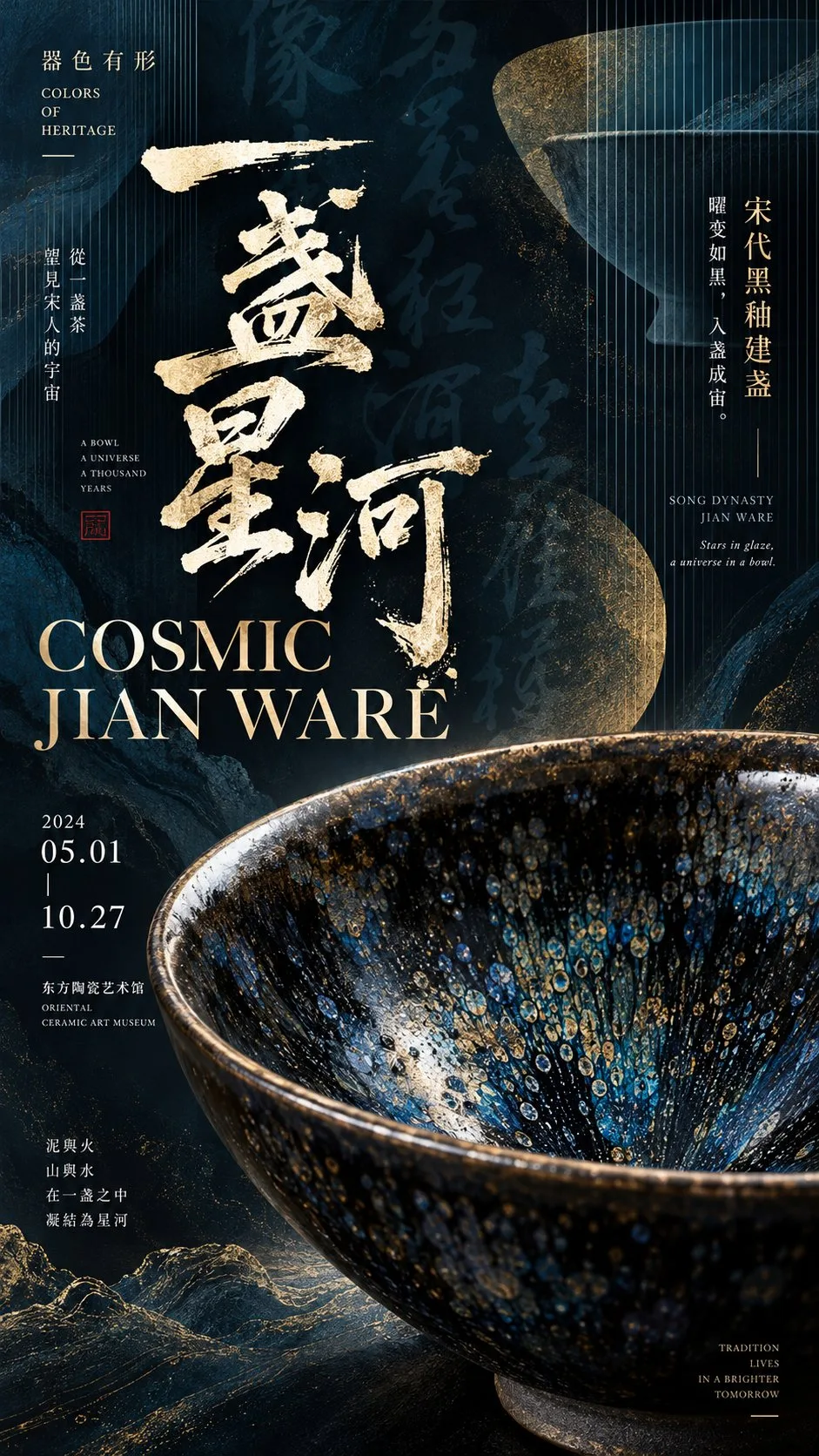
Make it yours
Change the text fields below, or leave them blank to keep the original. They fill the highlighted parts of the prompt.
Reference images
Copy the prompt and attach your own reference images in your generation tool. Follow the requirements below and match any image labels to the prompt. No image upload is needed on UNIP.
Author’s instructions · English
[Cultural Theme]: Fill in, e.g., Tang sancai, blue-and-white porcelain, Jun ware, Jian tea bowls
[Core Artifact]: Fill in the name, form, and material characteristics
[Chinese Main Title]: Fill in
[English Main Title]: Fill in
[Cultural Phrase]: Fill in
[Series Name]: 器色有形 / COLORS OF HERITAGE
[Primary and Secondary Colors]: Fill in
[Visual Mode]: Dark Mineral / Highly Saturated Contrasting Colors / Gradient Grating
[Aspect Ratio]: 9:16
Create a highly polished Eastern cultural heritage and museum art poster featuring experimental typography, combining traditional Chinese aesthetics, museum exhibition visuals, vintage editorial design, and modern experimental Typography.
I. Artifacts and Composition
Use one artifact with authentic cultural characteristics as the core visual, displayed at a large scale, with an accurate form, refined material textures, a natural glaze or surface texture, and layered light and shadow like museum collection photography.
Allow parts of the artifact to be enlarged and its edges to extend beyond the frame, with the artifact overlapping in front of and behind the text. Add one supporting artifact that is partially cropped or semi-transparent, using differences in size, tangible and ethereal appearance, orientation, and form to establish spatial layers.
II. Typography and Layout
Use enormous, powerful Chinese brush calligraphy for the Chinese main title, with natural brush-tip strokes, dry-brush white streaks, and variations in stroke thickness, making it an important visual graphic in the image.
Use a high-quality vintage serif typeface in uppercase for the English main title, interacting with the Chinese calligraphy and artifacts through enlargement, line breaks, offsetting, and overlap. A small amount of elegant English cursive lettering may be added as a supporting element.
The image must have a complete editorial information hierarchy, including the series name, artifact name, cultural classification, craftsmanship descriptions, short phrases in Chinese and English, and a few refined annotation lines. Information density should be medium to high, while maintaining a clear relationship between primary and secondary elements.
III. Colors and Background
Design according to the selected visual mode:
- Dark Mineral: Use colors such as ink black, deep blue, and copper-gold, combining mineral textures, localized metallic-color details, and semi-transparent calligraphic background patterns to convey a deep, weighty cultural character.
- Highly Saturated Contrasting Colors: Use two vivid main colors to divide large areas, accompanied by organic curves, artifacts offset beyond the frame, enormous typography, and low-contrast cultural motifs to create a vintage editorial design feel.
- Gradient Grating: Use gradient color fields such as cyan-blue and indigo-violet with spatial depth, overlaid with continuous, fine, closely spaced vertical gratings. The lines bend slightly at the edges of the artifact, vary in spacing, and overlap in front of and behind it, creating a modern optical-art effect in which the artifact is partially concealed and partially revealed.
Incorporate traditional calligraphy, decorative motifs, flowing glaze colors, or historical and cultural textures related to the theme into the background with low transparency, enriching the image without interfering with the main information.
IV. Visual Hierarchy and Finish
Build three main visual anchors with enormous Chinese calligraphy, the core artifact, and a large English title.
Create rich spatial layers and a reading rhythm through parts of the artifact extending beyond the frame, overlapping text, color contrasts, ghosted background imagery, and fine lines.
From a distance, the image should have a strong visual impact and clear overall forms; up close, viewers should discover refined materials, calligraphic textures, cultural information, and graphic details.
The entire poster should have the finish of professional cultural heritage and museum exhibitions, art publishing, and cultural brand design, becoming a complete work with its own thematic expression, rather than an ordinary artifact display template.
Ensure accurate artifact forms, clear text, precise layout, and mature use of color. Avoid garbled text, fabricated exhibition information, meaningless English, cheap-looking 3D, excessive technological effects, random numbering, four-pointed starbursts, and watermarks.
Finally, output one high-definition 9:16 vertical art poster.
Only the highlighted parts change. Your edits stay on this page.