
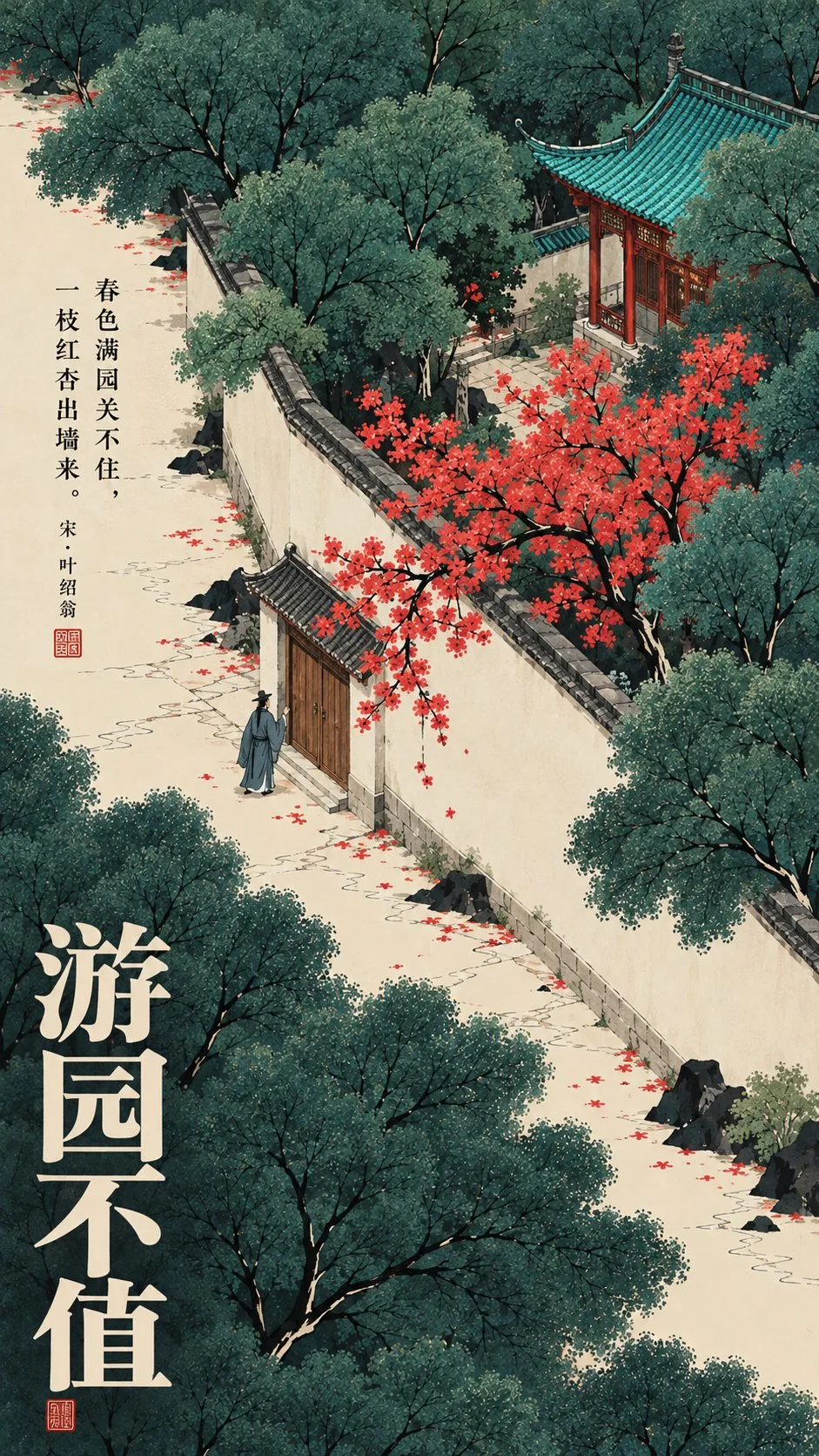
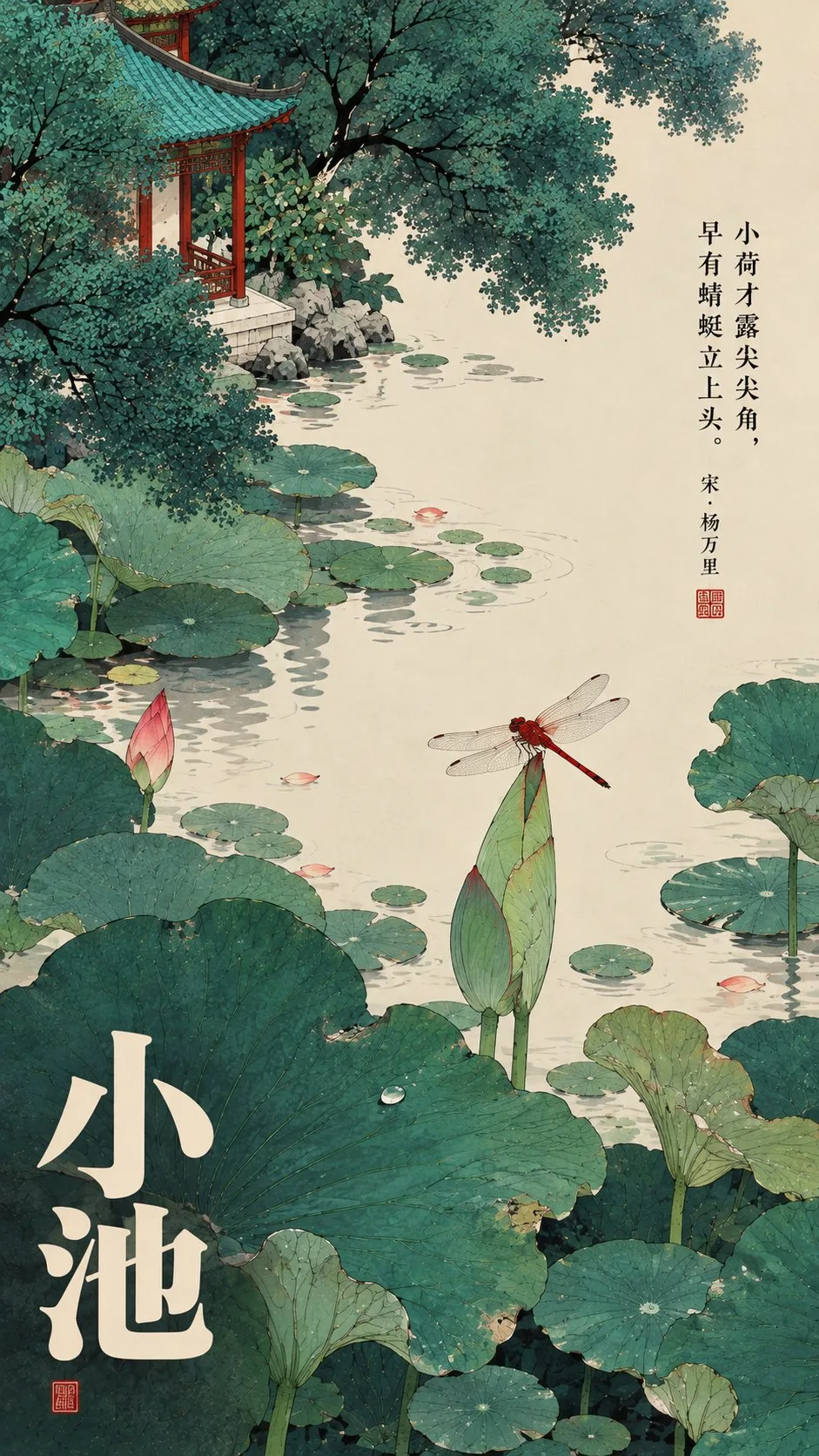
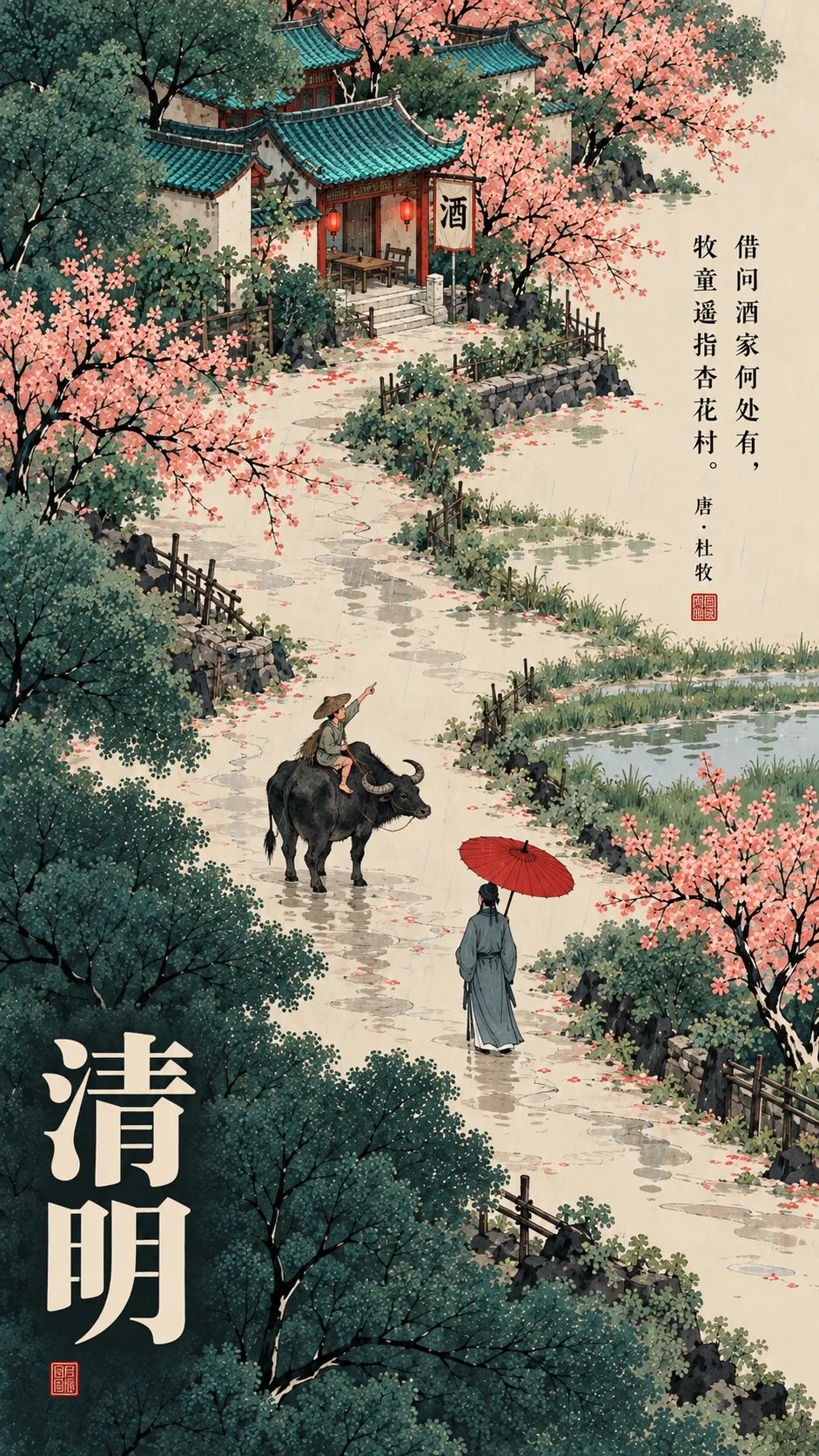
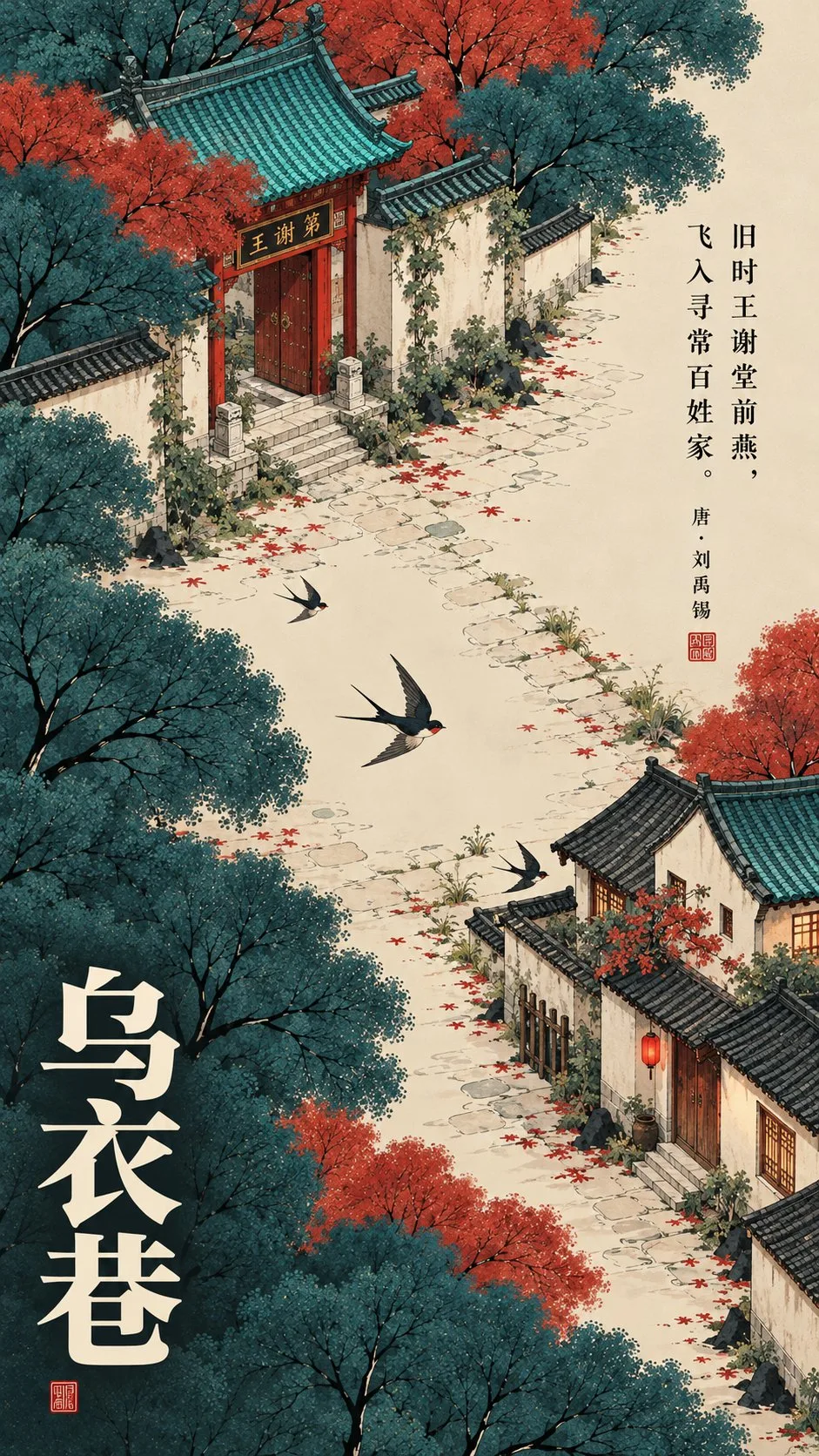
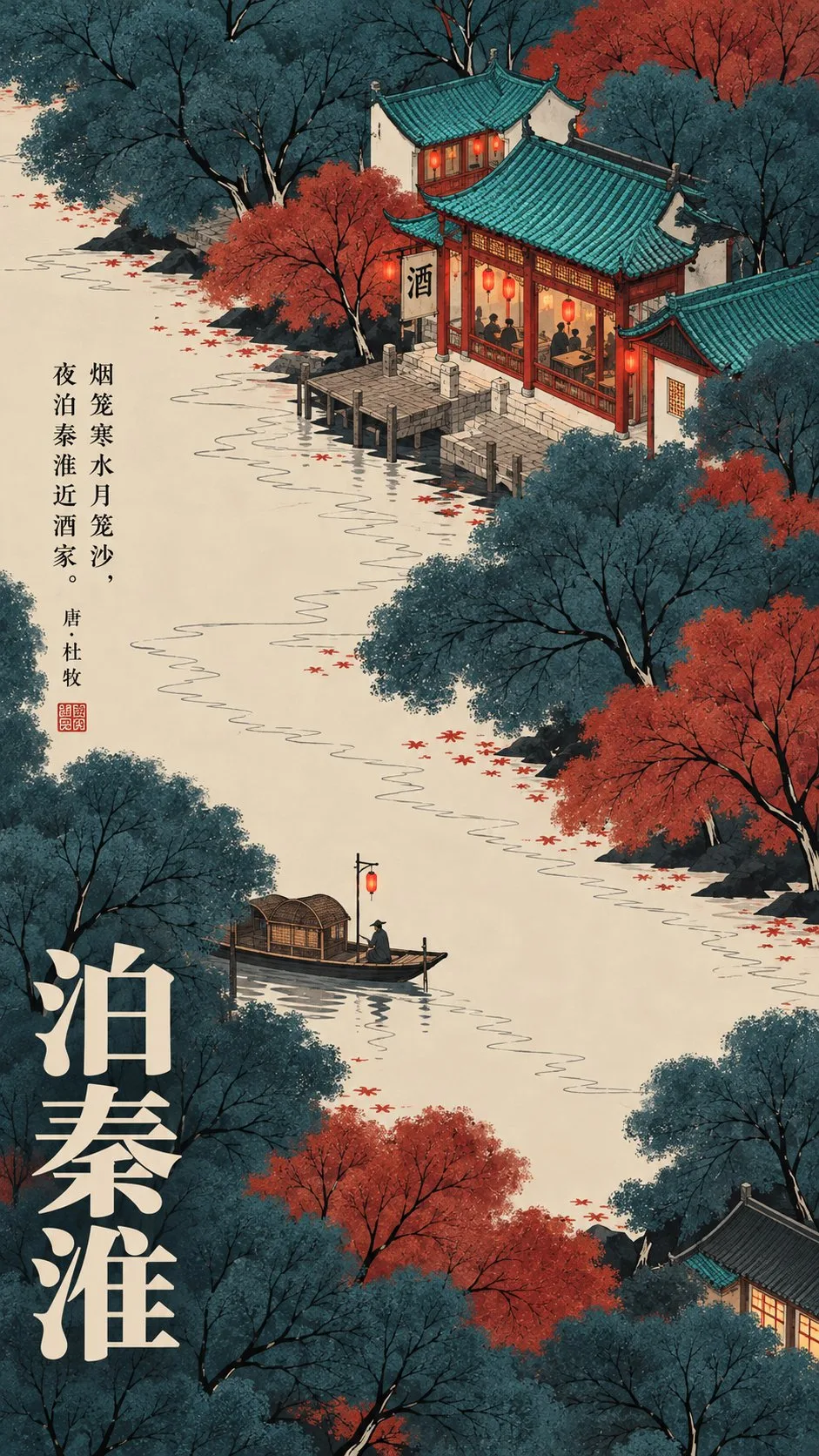
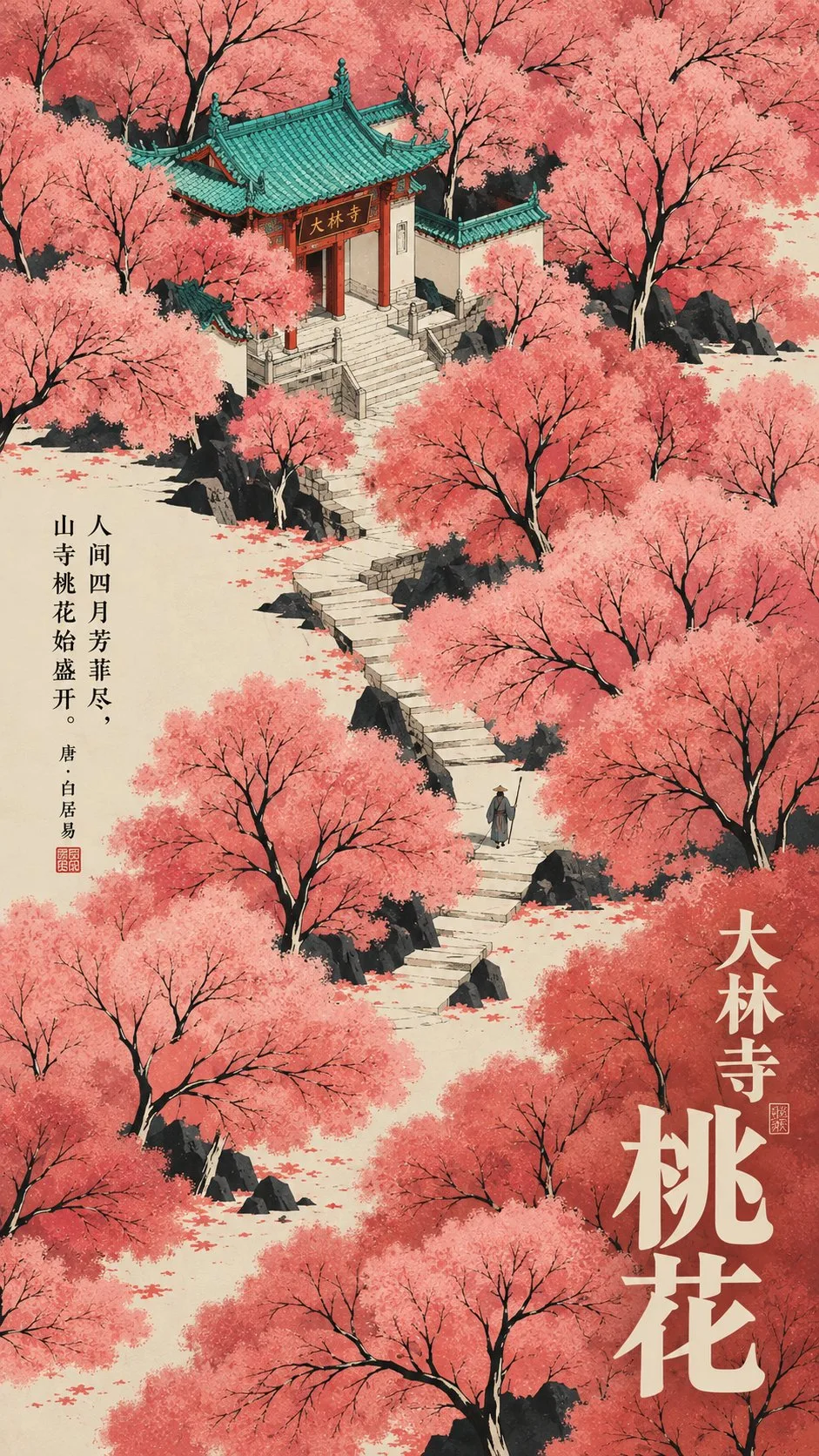
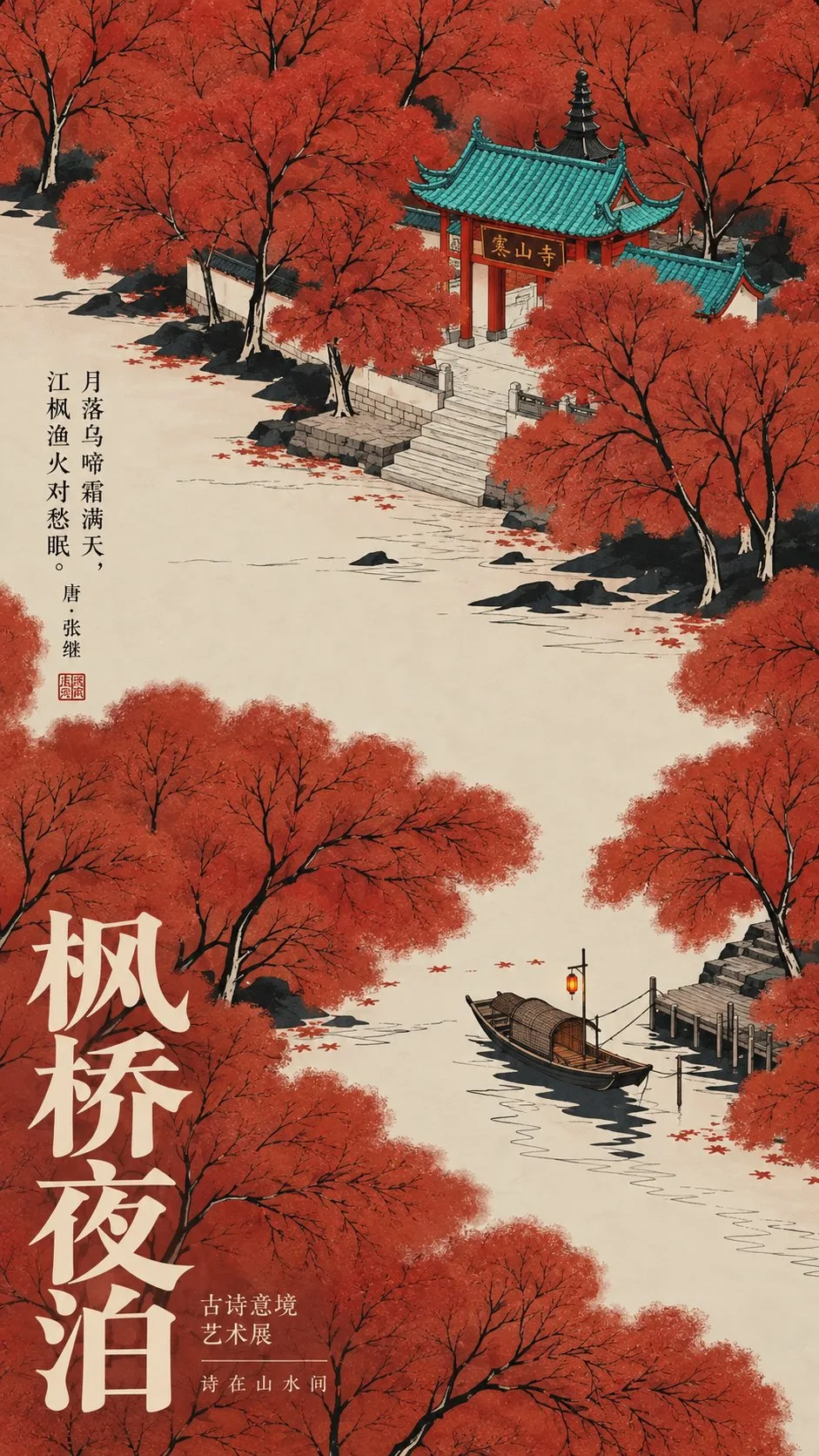
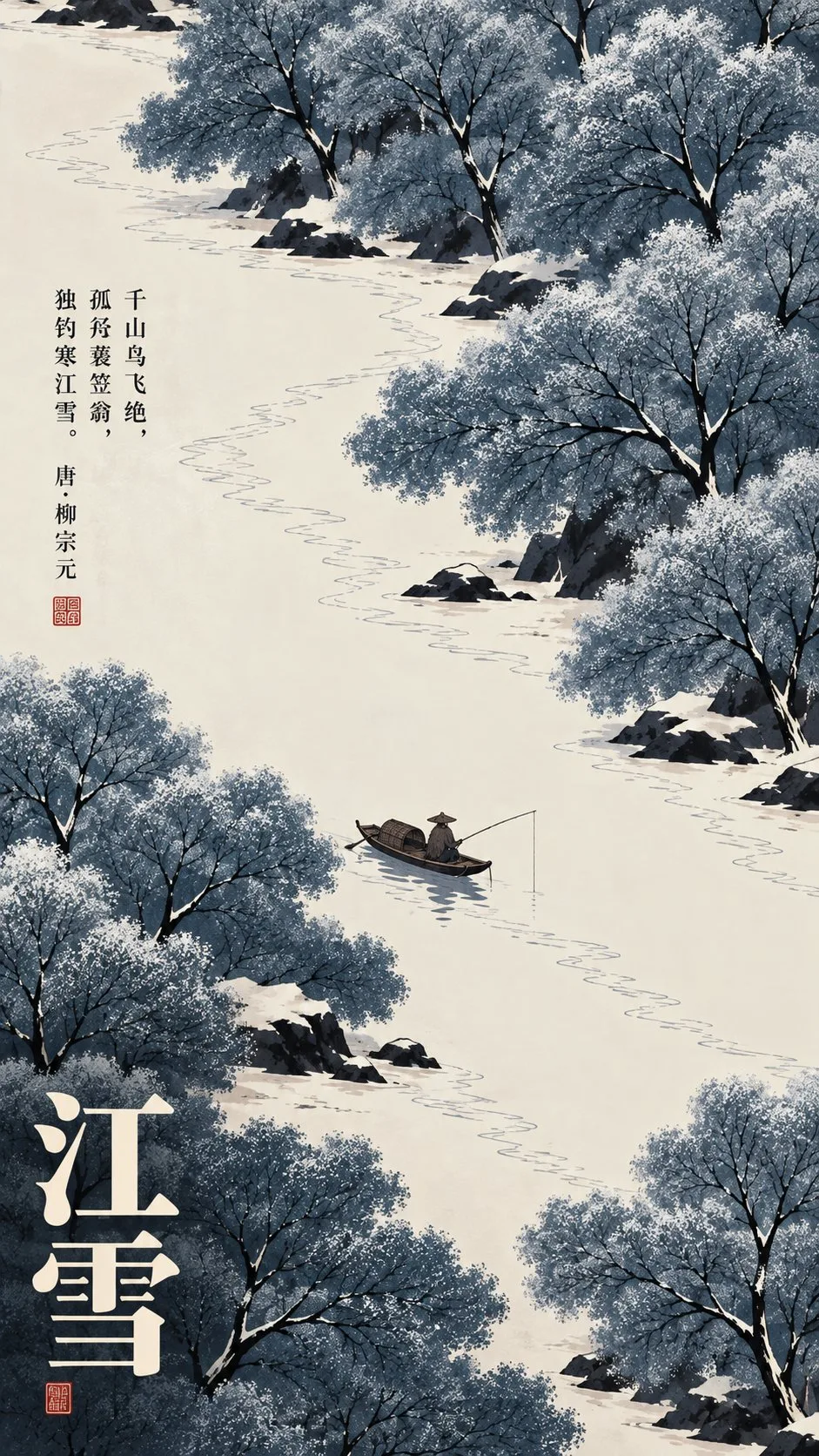
Classical Poetry as Narrative Scenes

Turn a poem’s scenery, actions and emotion into a clear visual narrative. Specify the core scene, key imagery and relationships between figures, animals and plants, then connect them with fine linework, flat traditional colors, cloud-like tree canopies and generous negative space. The poem, narrative action and palette can change while the illustration language and readable Chinese title-and-verse hierarchy remain consistent.
Customize prompt
Original prompt
Simplified Chinese
【古诗词】{标题、作者、原文}
【核心场景】{填写或由AI提取}
【关键意象】{填写或由AI提取}
【视觉关系】{如红杏越墙、蜻蜓立荷、牧童指路}
【主色调】{填写东方传统配色}
【画幅比例】9:16

根据古诗词创作一张新中式细线设色装饰插画海报,将诗中的景物、动作与情绪转化为具有明确视觉叙事的东方场景。

采用高位俯瞰、东方散点透视与现代平面构成。树冠呈柔软蓬松的云团状色块,边缘带有细腻粉末点染质感,内部穿插纤细连续的墨黑枝条。建筑采用精细工笔线描、青绿瓦片、暖白墙面与朱红木结构。

人物、动物和植物使用统一的精细线描与平面设色,动作自然,结构准确,主体之间的空间关系清楚。

地面与水面以暖米白大面积留白表现,辅以少量墨色阴影与简洁细线。构图根据诗词灵活变化,突出核心意象,保持主次清晰、疏密有序。

色彩采用石青、石绿、黛青、朱砂、赭红、象牙白等东方传统色系,设色饱满均匀、哑光干净,保留轻微纸本质感。

加入大幅暖白色中文标题、小型纵排原诗句、作者署名和少量朱印,形成完整的东方文化艺术海报。

避免写实摄影、3D、动漫、浓重水墨、油画厚涂、复杂背景、过度颗粒和人工做旧。

最终呈现教科书级精细插画质感,兼具东方美学、诗意留白与鲜明的视觉叙事。
English
[Classical poetry]{title, author, original text}
[Core scene]{fill in or have AI extract it}
[Key imagery]{fill in or have AI extract it}
[Visual relationships]{e.g. red apricot blossoms extending over a wall, a dragonfly perched on a lotus, a herdboy giving directions}
[Dominant palette]{fill in a traditional Eastern color palette}
[Aspect ratio]9:16

Create a decorative illustration poster in a contemporary Chinese style in fine linework and color based on the classical poem, transforming its scenery, actions and emotions into an Eastern scene with a clear visual narrative.

Use a high bird's-eye view, Eastern scattered-point perspective and modern graphic composition. Tree canopies form soft, fluffy, cloud-like blocks of color, with delicate powdery stippling along the edges and slender, continuous ink-black branches running through them. Use finely detailed gongbi linework, blue-green roof tiles, warm white walls and vermilion wooden structures for the architecture.

Render people, animals and plants with consistent fine linework and flat color, natural actions, accurate structures and clear spatial relationships between subjects.

Represent the ground and water with broad areas of warm ivory negative space, supplemented by a small amount of ink-colored shadow and simple fine lines. Vary the composition flexibly according to the poem, emphasize the core imagery, and maintain a clear hierarchy and orderly variation between dense and sparse areas.

Use a traditional Eastern palette of azurite blue, malachite green, dark indigo, cinnabar, reddish ochre and ivory white. Keep the color full and even, matte and clean, with a slight paper texture.

Add a large warm white Chinese title, small vertical lines from the original poem, the author's name and a few vermilion seals to form a complete Eastern cultural art poster.

Avoid realistic photography, 3D, anime, heavy ink wash, thick impasto oil painting, complex backgrounds, excessive grain and artificial aging.

The final result should have the finish of a textbook-quality finely detailed illustration, combining Eastern aesthetics, poetic negative space and a vivid visual narrative.