
Customize: Gongbi Deities and Sacred Companions
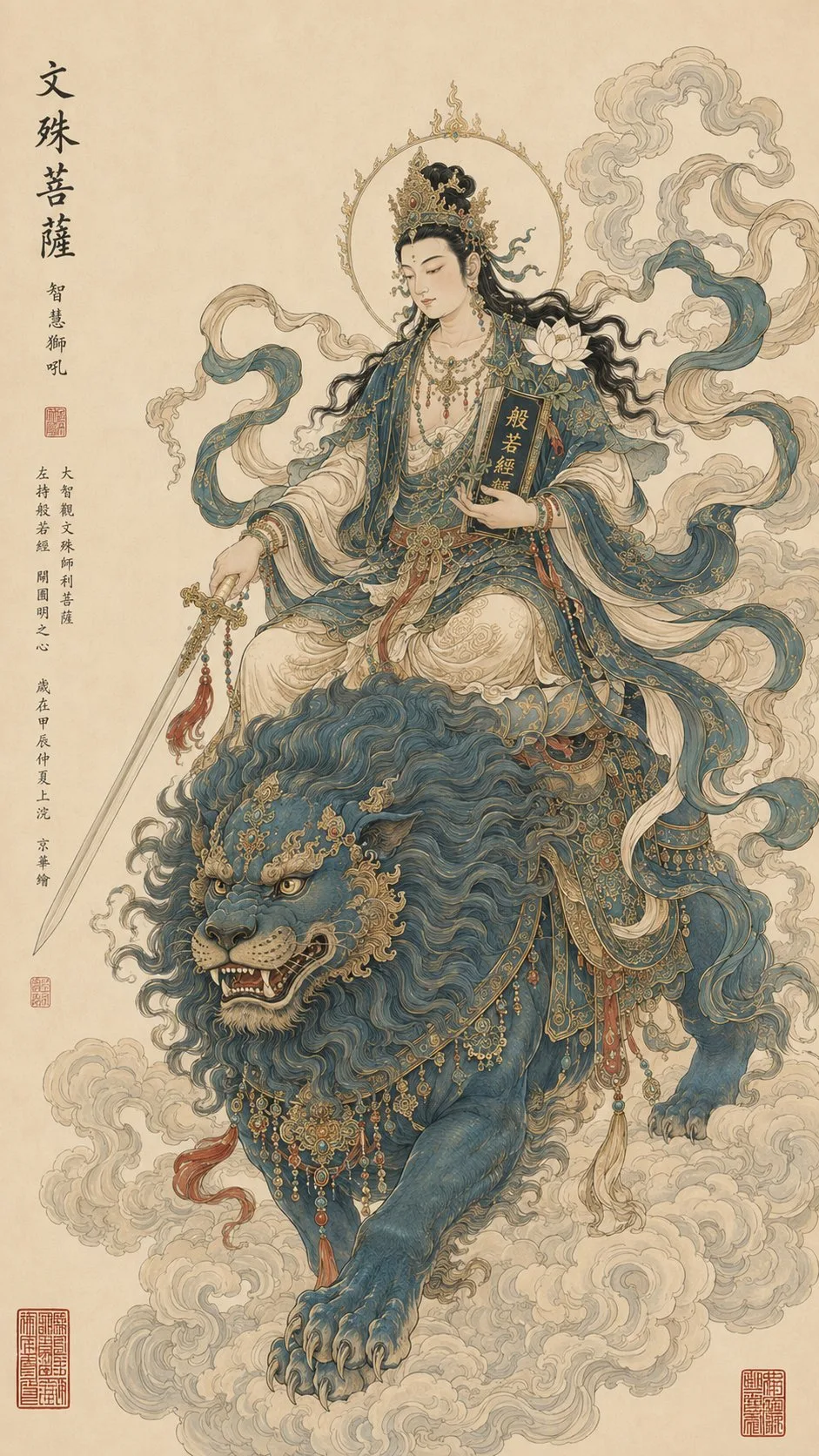
Prompt by @MrLarus. The image shows the original example.
Make it yours
Change the text fields below, or leave them blank to keep the original. They fill the highlighted parts of the prompt.
Reference images
Copy the prompt and attach your own reference images in your generation tool. Follow the requirements below and match any image labels to the prompt. No image upload is needed on UNIP.
Author’s instructions · English
[Deity Identity]: Manjushri Bodhisattva / Wide-Eyed Heavenly King / Vajra Guardian / Samantabhadra Bodhisattva / Other Deity
[Divine Beast / Ritual Implement]: Azure Lion / Red Dragon / Vajra / Six-Tusked White Elephant / Other
[Core Action]: Sit Upright and Command the Beast / Stand Imposingly / Step on Clouds / Encircle / Hold a Ritual Implement
[Main Color Palette]: Azurite Blue, Dusky Green, Cinnabar, Old Gold, Inky Blue-Green, Ivory White
[Composition]: Two Subjects Arranged Above and Below / S-Shaped Encircling / Frontal Dominance / Diagonal Momentum
[Overall Character]: Majestic, Sacred, Fierce, Strange, Solemn
[Aspect Ratio]: 9:16
Generate one Eastern deity icon illustration in gongbi with rich colors, using [Deity Identity] as the core subject and combining it with [Divine Beast / Ritual Implement] to establish a complete, clear, powerful compositional relationship. The figure, divine beast, ritual implements, flowing silk scarves, and cloud vapors should together form a distinct visual “momentum,” but the subject hierarchy must remain clear; avoid having every element compete for attention at the same time.
Combine the character of traditional Chinese deity paintings, richly colored gongbi painting, uncolored outline drawing and line engraving, and sacred-image scrolls from ancient books. The figure’s sacred form should be majestic, divine, and overpowering, with a complete traditional system of deity robes, armor, headdresses, and jeweled necklaces; the main motifs should include clouds, scales, fret patterns, scrolling foliage, lotuses, and animal masks.
Focus on maintaining “highly continuous gongbi line drawing”: the figure’s hair and beard, the divine beast’s fur, the dragon’s mane, feathers, and similar elements must follow their natural growth and the directions of their three-dimensional forms, shaping them with long, smooth, continuous, steady lines; flowing silk scarves, sleeves, the dragon’s body, the elephant’s trunk, and cloud vapors should use complete, large S-shaped and C-shaped curves, clearly connected from beginning to end. Reduce tiny fragmented textures; do not use random short lines, closely packed breaks, jagged fur, noise-like engraved lines, or meaningless small motifs.
Decorative motifs on the armor, crown, clothing, and divine beast should be “few and complete,” prioritizing complete, closed, large motifs and continuous borders. Complexity should come from a clear structural hierarchy rather than large quantities of tiny fragmented patterns.
Use traditional rich mineral colors with low saturation that are nonetheless full, even, and continuous, centered on [Main Color Palette]. Colors such as azurite blue, malachite green, inky blue-green, old gold, copper-gold, cinnabar, ochre red, and ivory white should form clear, large color blocks; color within each area should remain stable and complete, with light-to-dark transitions naturally following the structure. Avoid random mottling, fading, stains, granules, artificial aging, and uneven color blocks.
Use clean, soft-toned xuan paper in warm ivory for the background, retaining only extremely subtle natural paper fibers, with large areas of blank space and a small amount of cloud vapor drawn in continuous lines. The sense of antiquity should come from gongbi lines, mineral coloring, xuan paper, calligraphic inscriptions, and vermilion seals; it should not rely on artificial aging.
The image must include a traditional inscription system from classical paintings: one column of the deity’s name in medium-sized lettering, one column of a smaller subtitle, a few fine inscriptions, and 3–5 vermilion seals in varied sizes and staggered positions. Text is part of the image’s structure, but it must not overpower the figure and divine beast, and it should not become a large modern poster-style title.
Follow the principle of “high density in the main subject, low density in the background”: the figure’s face, the divine beast’s head, the ritual implements, and the core armor areas should contain the richest detail; large areas of robes and the divine beast’s body should maintain medium density; cloud vapors and the xuan-paper background should be the sparsest.
Only the highlighted parts change. Your edits stay on this page.